policy and funding
Energy UK backs gas standing charge removal but presses for low-income safeguards
The trade body welcomed the Government's Budget-day plan to move gas standing charges onto the unit rate for 23 million homes, but said households who lose out must be protected.
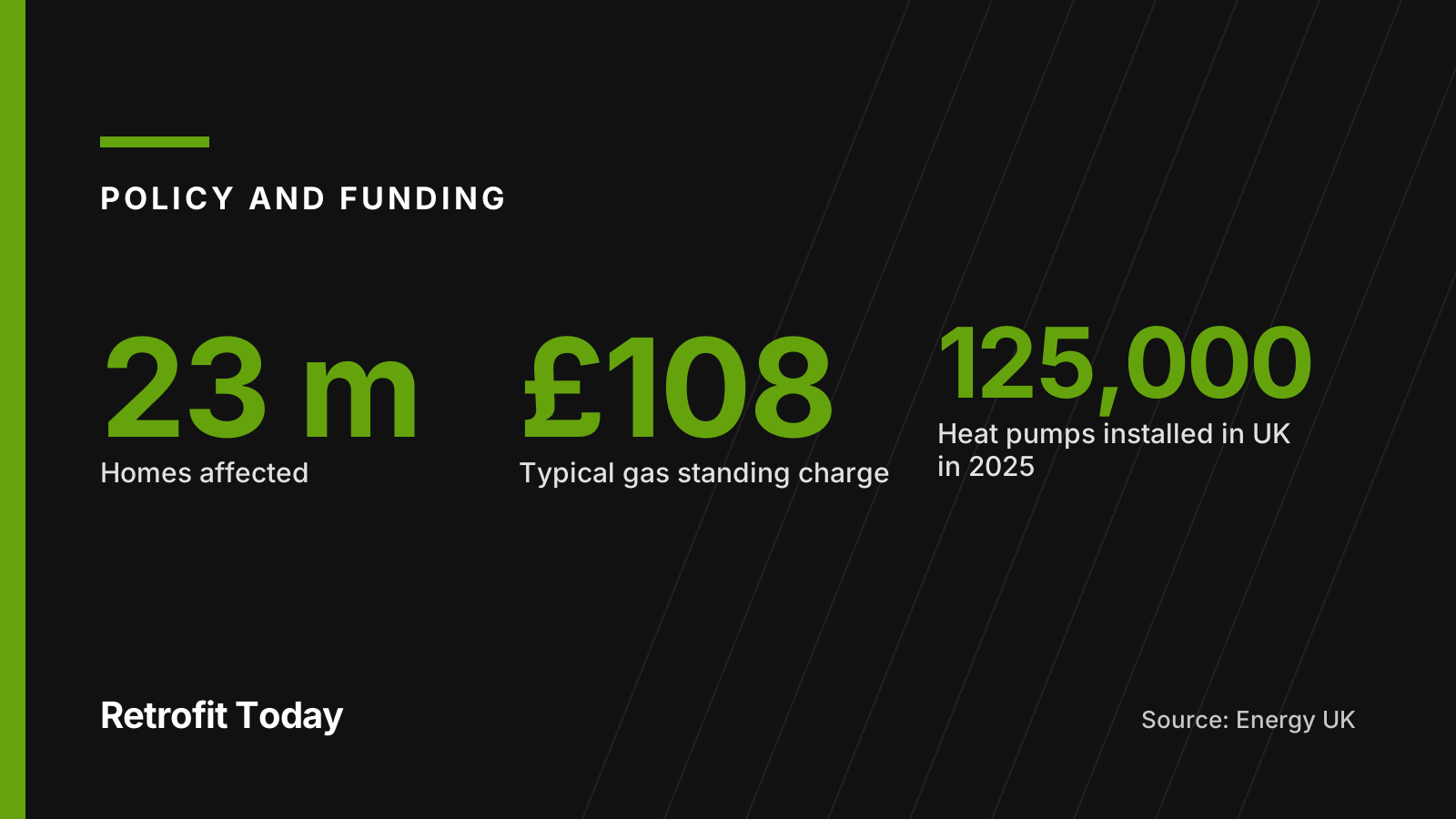
Energy UK has welcomed the Government's announcement on 28 October 2026 that gas standing charges will be moved onto the unit rate for around 23 million homes, but said low-income households who would lose out must be supported.
The Government said the fixed costs currently recovered through the gas standing charge, which it put at £108 a year for the typical household on average, will instead be paid through the unit rate. The announcement came ahead of the Budget on the same day.
Dhara Vyas, Chief Executive of Energy UK, said moving the costs onto the unit rate would be good news for many customers, but "it will be very important to support those low-income households who will otherwise lose out".
The Chancellor will ask Ofgem to deliver the removal of the charges in 2027 or as soon as possible after, according to the Government. It said the change could save 60% of account-holding households an average of around £45 a year, and that it will set out targeted mitigation for a small number of households in due course.
The timetable
Energy UK's position on timing differs from the Government's. The trade body said its Sparking Change report, produced with Mitsubishi Electric and published on 20 October 2026, recommended moving the gas standing charge onto the unit rate from April 2028, accompanied by a social discount scheme to protect low-income households who have no choice but to use a lot of gas.
Energy UK also said it would be important to ensure the change does not increase suppliers' financial risk.
Vyas said standing charges cover the fixed infrastructure and operational costs of keeping homes connected to the energy system, and that those costs would need to be recovered elsewhere. "So it is critical the Government and Ofgem work closely with industry and consumer groups on implementation," she said.
Energy UK said the change would address a problem faced by prepayment customers who use gas only for winter heating. Those customers build up a backlog of standing charges over the summer, which must be paid off before they can start using their heating again, the trade body said.
The spark gap
For the retrofit sector, the significance lies in the ratio of electricity to gas prices, known as the spark gap. Energy UK's report recommended that the Government target a 3:1 domestic spark gap by 2030, as part of a long-term ambition to reach 2.5:1.
The report said narrowing the spark gap could see at least an additional 250,000 heat pumps installed by 2030. It said around 125,000 heat pumps were installed in the UK in 2025.
Energy UK said its package of measures could save a typical dual-fuel household around £40 a year, or £300 a year if they install a heat pump. In the report's foreword, Vyas wrote that the single most significant thing the Government can do to support electrification is to reduce the price of electricity relative to gas.
Greg Jackson, Founder and CEO of Octopus Energy Group, was quoted in the Government's release saying the change would further improve the ratio of electricity to gas prices.
Ofgem's position
Ofgem has previously set out limits to what reallocating standing charges can achieve. In September 2025, when it confirmed plans to require all major suppliers to offer at least one tariff with a lower standing charge, the regulator said it cannot remove the costs that make up the standing charge from the system, only move them from one part of the bill to another. It said that requirement was unlikely to reduce bills because such tariffs carry higher unit rates.
In its December 2024 standing charges review update, Ofgem said many low-income or vulnerable consumers could be hurt by a change in how standing charges are allocated. It said tens of thousands of consumers had responded to its call for input to express dissatisfaction with the current system.
Ofgem has already shifted some costs. From April 2026 it moved Warm Home Discount costs from standing charges to the unit rate, cutting standing charges by an average of £13, or 4p a day, for dual-fuel customers. The regulator said the main driver of that cap reduction was the change to policy costs announced by the Chancellor in the budget.
Under the current price cap, covering 1 October to 31 December 2026, the gas daily standing charge for Direct Debit customers is 29.68p a day and the average gas unit rate is 7.97p per kWh, according to Ofgem. The regulator said energy prices rose by 4% from 1 October 2026 for a typical dual-fuel household paying by Direct Debit.
Energy UK describes itself as the trade association for the energy industry, with members delivering nearly 80% of the UK's power generation and over 95% of energy supply to 28 million UK homes.
Ofgem will announce the price cap for 1 January to 31 March 2027 by 25 November 2026.
On the record: Department for Energy Security and Net Zero
Sources
- Energy UK (opens in a new tab) (accessed 2026-10-28)
- HM Treasury, Prime Minister's Office and Department for Energy Security and Net Zero (GOV.UK) (opens in a new tab) (accessed 2026-10-28)
- Energy UK (opens in a new tab) (accessed 2026-10-28)
- Ofgem (opens in a new tab) (accessed 2026-10-28)
- Ofgem (opens in a new tab) (accessed 2026-10-28)
- Ofgem (opens in a new tab) (accessed 2026-10-28)
- Ofgem (opens in a new tab) (accessed 2026-10-28)
- Energy UK (opens in a new tab) (accessed 2026-10-28)
This story was researched from the primary sources above and checked against them before publication. Spotted an error? Tell us and we will correct it promptly.