policy and funding
Peabody sets 2031 deadline for all rented homes to reach EPC C in new five-year strategy
The housing association's 2026-31 Sustainability Strategy and Climate Transition Plan commits to EPC C or better across its rented stock, with every directorate given its own sustainability action plan for the first time.
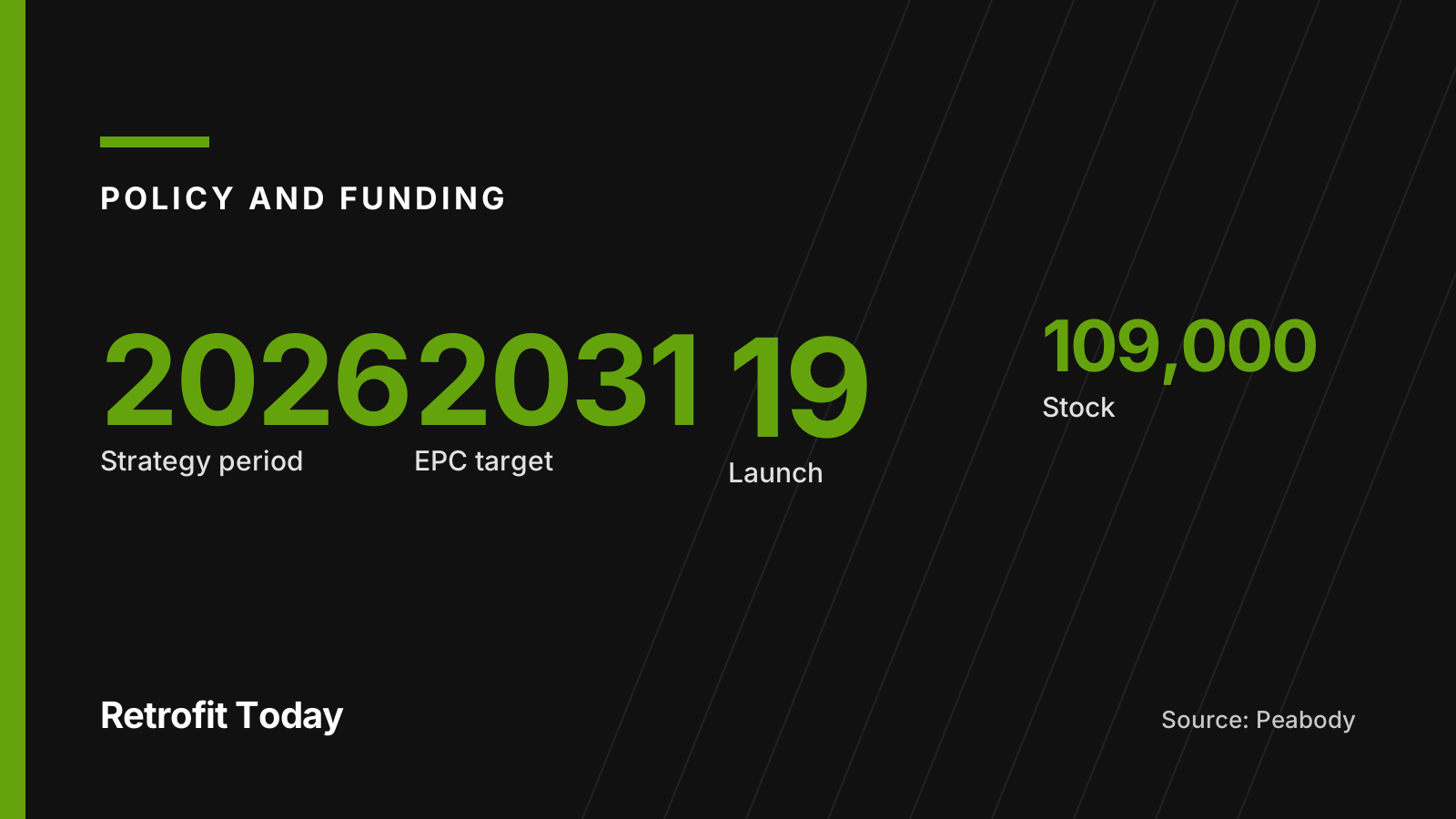
Peabody has launched a five-year Sustainability Strategy and Climate Transition Plan for 2026 to 2031 that commits the housing association to bringing all of its rented homes to EPC C or above by 2031.
The landlord, which says it is responsible for 109,000 homes and 220,000 residents across London and the home counties, launched the strategy at Thamesmead on Monday 19 October. Chair Caroline Corby invited about 100 of the organisation's leaders and sustainability champions to the event.
Alongside the energy performance certificate (EPC) target, Peabody said the plan covers improving heating systems and exploring more opportunities for renewable energy. The accompanying Climate Transition Plan sets out actions to 2031 alongside a longer-term ambition of net zero by 2050.
Richard Ellis, Director of Sustainability at Peabody, said: "The next five years are about turning that progress into practical, measurable action across Peabody."
Directorate action plans
For the first time, Peabody said, every directorate has its own sustainability action plan setting out its contribution to cutting the organisation's environmental impact and preparing for a changing climate. Ellis said climate performance would become part of how Peabody maintains homes, designs services, works with suppliers, invests money and makes decisions.
The strategy is organised around four areas: better homes to live in, greener and more resilient neighbourhoods, using resources well, and making better decisions for the long term.
The resilience strand covers preparing homes and neighbourhoods for hotter summers, heavier rainfall and flooding, using better information to identify where risks are greatest. Peabody said it would also invest in green spaces and biodiversity and work with residents and local partners on improvements suited to each neighbourhood.
The launch event included planting the first of 4,000 trees across Peabody neighbourhoods, one for every colleague.
Shift from the 2030 target
The 2031 deadline differs from the commitment in Peabody's previous Sustainability Strategy 2023-26, published in October 2023. That document committed the organisation to making its rented homes at least EPC C by 2030. Peabody's announcement gives no reason for the change in date.
An investor note from September 2023 set an interim target of more than 80% of homes at EPC C or above by 2026. Peabody's full-year results, reported in June 2025, said that over 80% of its homes were rated EPC C or above. The same 2023 note committed Peabody to building all new homes from 2025 to at least EPC B.
Peabody said that over the past three years it has cut its carbon emissions by 10% and improved more than 1,500 homes to EPC C through retrofit programmes.
The funding picture
Peabody said it has secured £48.5m in government funding over the past three years to support further improvements. Its announcement does not break that figure down.
Separately, the Department for Energy Security and Net Zero's list of Warm Homes: Social Housing Fund Wave 3 recipients, updated on 7 November 2025, records a grant of £23,478,820 offered to and accepted by Peabody Trust as consortium lead with Town and Country Housing.
Peabody's results for the year to 31 March 2025 said it spent £30m on energy efficiency measures in that year, using £15m from Social Housing Decarbonisation Fund Wave 2. Overall spending on looking after residents' homes that year was £430m.
Grant funding has been supplemented by borrowing. In July 2025 Peabody secured a £60m loan from Lloyds Banking Group, partially guaranteed by the government's National Wealth Fund, to improve the energy efficiency of thousands of homes. The loan funds measures including solar panels, loft and wall insulation, low-energy lighting, heat pumps and water-saving technologies.
Peabody has also looked at technology to help target retrofit work. In October 2023 it received £240,000 from Innovate UK with Kestrix and United Living Property Services to develop drone thermal imaging for prioritising retrofit, which Peabody said at the time would be tested first on a sample of about 100 of its homes.
Working with residents
Elly Hoult, Deputy Chief Executive and Chief Operating Officer, said: "Residents know their homes and neighbourhoods better than anyone. Working with them, listening to their experiences and acting on local priorities will be essential to making improvements that last."
Peabody said it would work with residents, colleagues, suppliers, councils and other partners over the next five years to turn the plans into practical improvements, with the strategy's EPC C commitment for all rented homes falling due in 2031.

On the record: Peabody Trust, Department for Energy Security and Net Zero
Sources
- Peabody (opens in a new tab) (accessed 2026-10-21)
- Peabody (opens in a new tab) (accessed 2026-10-21)
- Peabody (opens in a new tab) (accessed 2026-10-21)
- Peabody (opens in a new tab) (accessed 2026-10-21)
- Peabody (opens in a new tab) (accessed 2026-10-21)
- GOV.UK (Department for Energy Security and Net Zero) (opens in a new tab) (accessed 2026-10-21)
- Peabody (opens in a new tab) (accessed 2026-10-21)
- Peabody (opens in a new tab) (accessed 2026-10-21)
This story was researched from the primary sources above and checked against them before publication. Spotted an error? Tell us and we will correct it promptly.