policy and funding
BESA, IOR and CEFEP back TICA campaign on external heat pump pipe insulation
The Proof is on the Roof campaign, launched in 2025 to end the use of non-UV resistant flexible foam insulation on external services, is now backed by three industry bodies.
The Building Engineering Services Association (BESA), the Institute of Refrigeration (IOR) and European foam insulation body CEFEP have backed a campaign calling for an end to non-UV resistant flexible foam insulation on externally located building services.
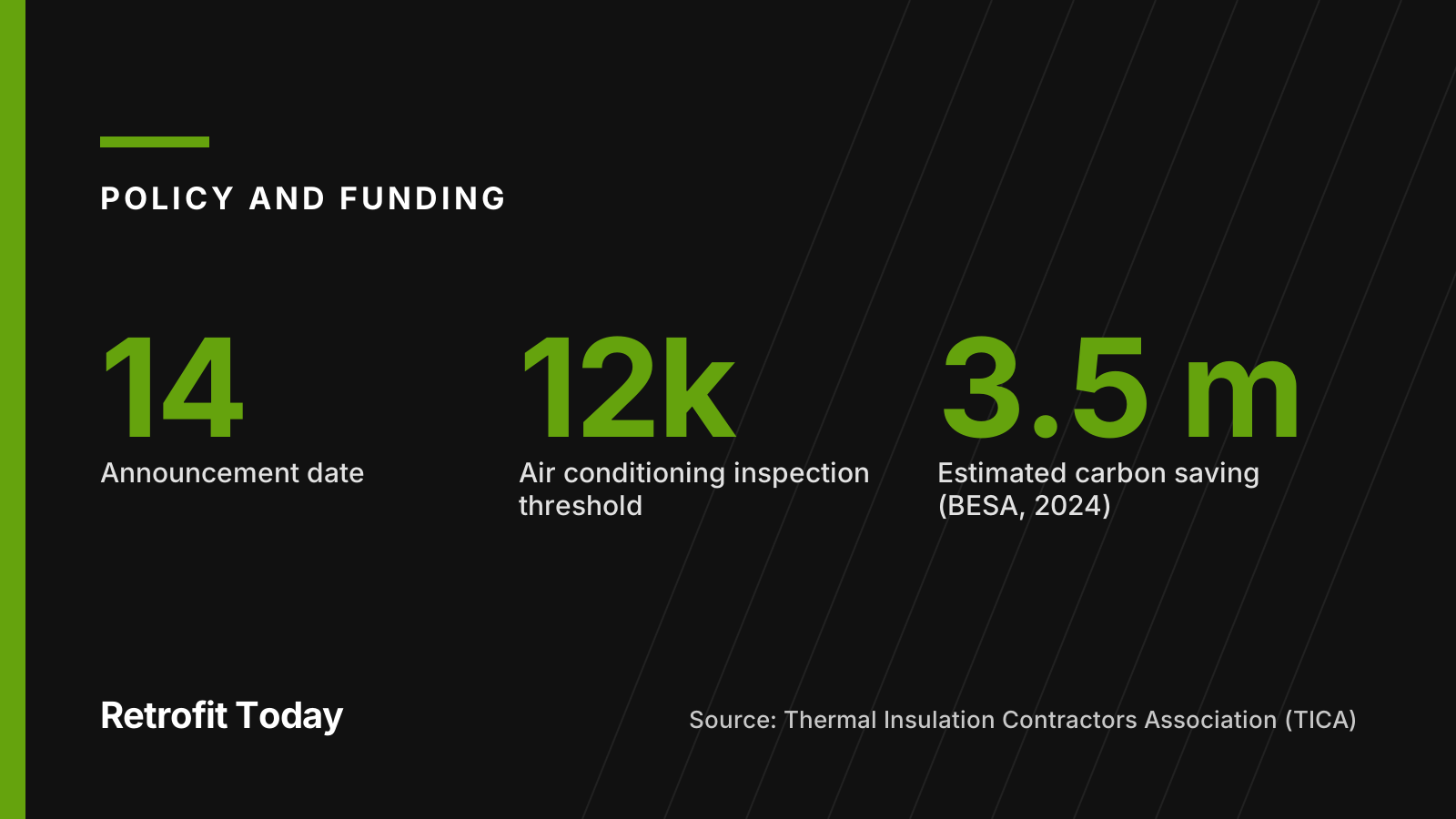
The Thermal Insulation Contractors Association (TICA) said on 14 October that the three bodies now support its Proof is on the Roof campaign, which it launched in 2025 with refrigeration efficiency expert Lawrence Leask FInstR, managing director of Kaizen Energy Consultancy.
According to TICA, Leask and its technical director Chris Ridge started the campaign after Leask found degraded refrigeration pipe insulation on nearly all of his TM44 inspections. Leask said the energy lost through incorrectly specified and installed thermal insulation was equivalent to the output of a large power station.
Chris Ridge, TICA's technical director, said: "Thermal insulation of pipework is a genuine low hanging fruit for decarbonisation, but it is often no more than an afterthought." He added that policymakers should not ignore the scale of energy losses from poorly insulated pipework.
The competence gap
TICA said most pipe insulation work needs a thermal insulation specialist, but commercial air-to-air heat pump installations are usually insulated by the refrigeration contractor.
Competence frameworks for the refrigeration, air conditioning and heat pump trades are being developed, and the campaigners said this offered a chance to close the knowledge gap on specifying and installing thermal insulation correctly.
Kevin Morrissey, technical director of BESA, said: "This is another excellent example of an easily rectified, widespread problem that would make a significant contribution to improving performance and reducing environmental harm." He said the solutions existed and the financial case was persuasive, and that industry bodies should work together to support TICA's campaign.
The IOR said in a statement that growth in heat pump installations highlighted the importance of getting installations right, and that the campaign had drawn attention to an issue that could be easily resolved.
Tom Merton, technical manager at CEFEP member Armacell, said UV and weather-resistant insulation helped maintain thermal performance and condensation control while reducing the risk of cracking, moisture ingress and premature replacement.
CEFEP describes itself as the industry association for FEF and PEF insulation, representing European manufacturers of elastomeric and polyethylene foam insulation.
The supporting associations said improvements could be made immediately using products and solutions that already exist. Leask asked whether other stakeholders, including the Government and heat pump equipment manufacturers, would take the issue seriously.
Background
Government guidance on statutory air conditioning inspections, published on GOV.UK, says the regulations apply only to systems with an effective rated output of more than 12kW, that inspections must be no more than five years apart, and that an inspection report must be produced by an accredited energy assessor.
In June 2025 TICA said Ridge and Leask would issue an industry-wide call to action urging HVAC professionals to prioritise thermal insulation. TICA said the message would be delivered in a session titled "Is Your Plant Room An Energy Crime Scene?" at the Installer Show at the NEC Birmingham, and it encouraged the sector to use the hashtag #TheProofIsOnTheRoof to highlight good and bad practice.
In October 2025 TICA published good practice guidance on insulating externally located heat pump pipework, produced with trade bodies including the IOR and BESA. At its launch Ridge said there was confusion about what "good" looks like in heat pump insulation.
BESA and TICA had earlier, in September 2024, described uninsulated or poorly insulated pipework as the "lowest of low hanging fruit" among building retrofit measures. BESA said research it cited at the time estimated an annual saving of almost 3.5 million tonnes of carbon emissions.
On the record: Building Engineering Services Association
Sources
- TICA ACAD (opens in a new tab) (accessed 2026-10-14)
- TICA ACAD (opens in a new tab) (accessed 2026-10-14)
- TICA ACAD (opens in a new tab) (accessed 2026-10-14)
- GOV.UK (Department for Levelling Up, Housing and Communities) (opens in a new tab) (accessed 2026-10-14)
- Building Engineering Services Association (BESA) (opens in a new tab) (accessed 2026-10-14)
- CEFEP (opens in a new tab) (accessed 2026-10-14)
This story was researched from the primary sources above and checked against them before publication. Spotted an error? Tell us and we will correct it promptly.