policy and funding
Passivhaus Trust urges responses to Scotland's Stage 2 Passivhaus equivalent consultation
The Passivhaus Trust has asked individuals and organisations to respond to the Scottish Government's Stage 2 consultation on a Passivhaus equivalent standard before it closes on Friday 16 October 2026.
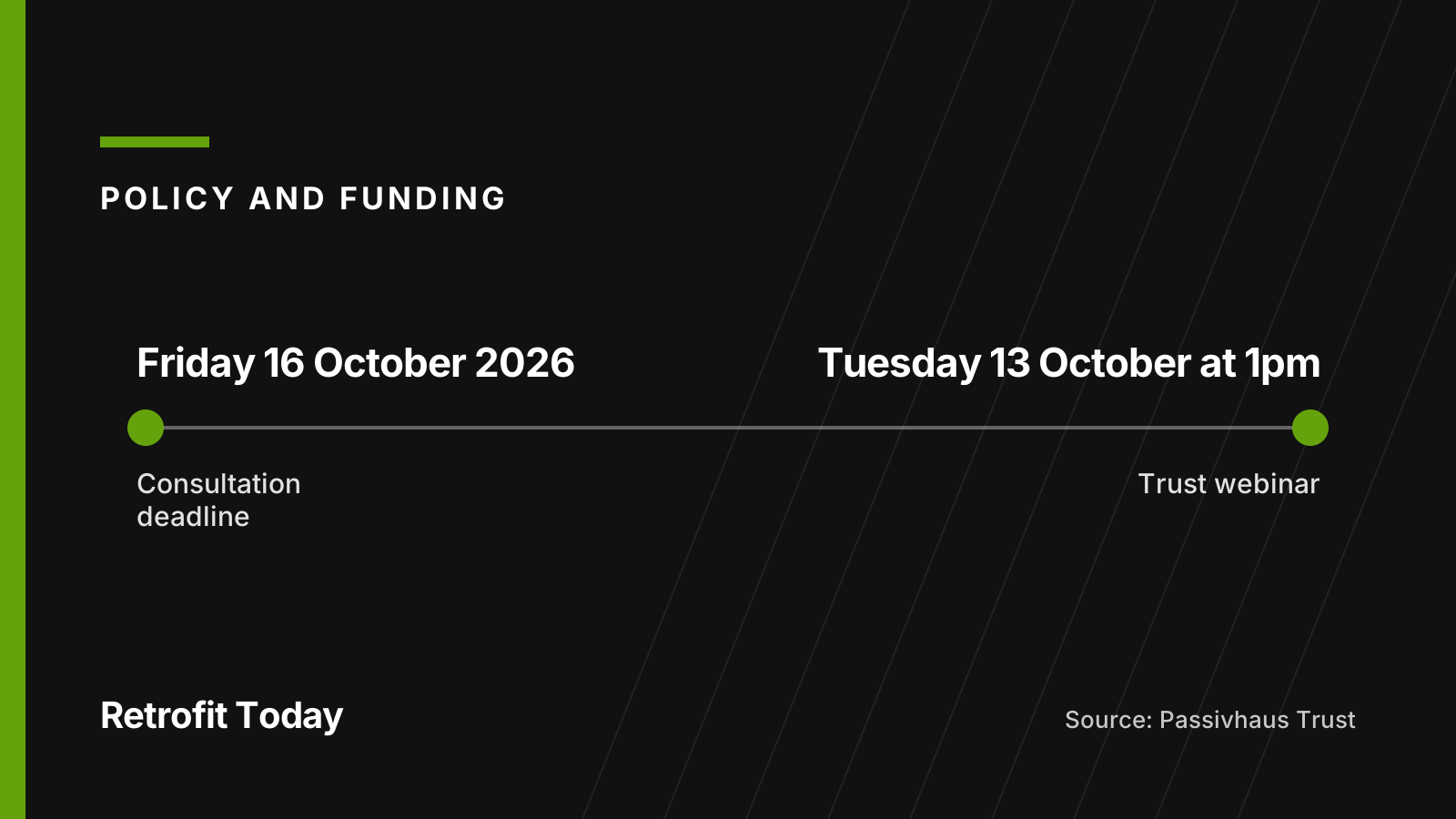
The Passivhaus Trust is calling on individuals and organisations to respond to the Scottish Government's Stage 2 consultation on its proposed Passivhaus equivalent policy. The Trust says responses are due by Friday 16 October 2026.
According to the Scottish Government, the Stage 2 consultation seeks views on proposed energy and environmental performance targets for the new standard and on proposals for an enhanced compliance process. It also asks whether the standard should be mandatory with phased implementation, or adopted voluntarily before compliance becomes mandatory.
What the Trust is asking for
The Trust has published a detailed response to the consultation, which has 33 questions, along with summary points for 16 questions it regards as key. Its main positions are:
- Timing. The standard should become mandatory as soon as practical and no later than Autumn 2029. The Trust supports voluntary adoption as a transition, provided it does not delay mandatory implementation.
- Certified Passivhaus. The Trust strongly supports the proposed deemed-to-satisfy route for fully Certified Passivhaus buildings, which it says gives a clear mechanism for recognising the established standard within Scottish Building Standards.
- Space heating. The Trust supports a space heating demand compliance metric but disagrees with a target space heating rate based on fabric alone. It argues that a fabric-only figure does not represent actual heating demand, because ventilation losses are integral to a building's energy balance.
- Energy reporting. The Trust supports reporting unregulated energy alongside regulated energy. It says the Scottish Passivhaus Equivalent Working Group unanimously agreed that energy use intensity (EUI) should be one of the metrics in the regulations.
A difference over the name
The Scottish Government describes the proposal as a Scottish equivalent to the Passivhaus standard. The Trust takes a different view on the name. It recommends the term "Passivhaus Informed", arguing that the standard should not be described as equivalent until its performance in practice has been demonstrated.
The Trust says the Passivhaus Standard itself has been developed and tested over more than 30 years across different building types and climate zones.
How the policy reached this point
The Scottish Government says it committed in December 2022 to legislate for a Scottish equivalent to the Passivhaus standard, in response to a bill proposed by Alex Rowley MSP. A working group to support the review was convened in June 2023, and the Stage 1 consultation ran between July and October 2024.
The government's working group page states that the implementation date will move from March 2028 to Autumn 2029, to maintain a sufficient lead-in period for industry preparation.
In an earlier update on the Scottish Government's December 2025 progress report, the Trust reported that regulated delivered energy use would remain the primary compliance metric for standard 6.1.
The Trust's own FAQ on the policy says 97% of Scotland's Climate Assembly voted in favour of the Passivhaus or Scottish equivalent standard. It also estimates that 35 Passivhaus schools are under way or in the pipeline in Scotland.
What happens next
The Trust is holding a final "respond-along" lunchtime webinar on Tuesday 13 October at 1pm, offering step-by-step support for those completing the consultation. It asks organisations to consider answering all 33 questions, drawing on its detailed response.
The consultation closes on Friday 16 October 2026.
Sources
- Passivhaus Trust (opens in a new tab) (accessed 2026-10-02)
- Scottish Government (opens in a new tab) (accessed 2026-10-02)
- Scottish Government (opens in a new tab) (accessed 2026-10-02)
- Passivhaus Trust (opens in a new tab) (accessed 2026-10-02)
- Passivhaus Trust (opens in a new tab) (accessed 2026-10-02)
This story was researched from the primary sources above, written with AI assistance and checked against those sources before publication. Spotted an error? Tell us and we will correct it promptly.