retrofit programmes
RUH Bath switches on 650 solar panels as £21.6m heat decarbonisation nears completion
The Royal United Hospitals Bath NHS Foundation Trust has energised 650 rooftop solar panels under Project Clean Heat, with rooftop heat pumps due to start running later this year.
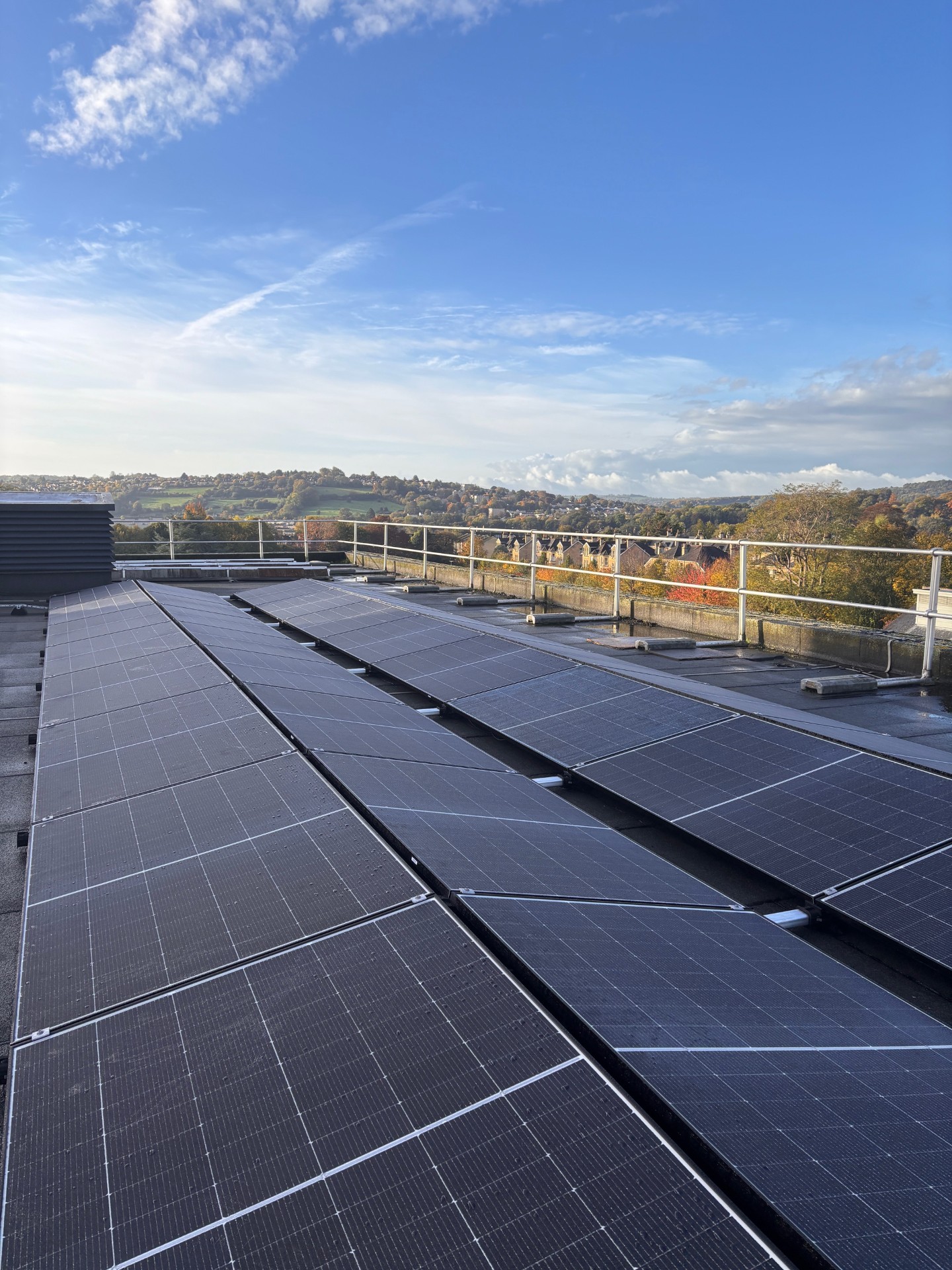
The Royal United Hospitals (RUH) Bath NHS Foundation Trust has switched on 650 new solar panels at its Combe Park site, the latest stage of Project Clean Heat, a heat decarbonisation programme funded through the Public Sector Decarbonisation Scheme (PSDS).
The Trust said the panels alone would save 42 tonnes of carbon a year, about the annual emissions of seven typical UK households. Salix, which administers the scheme, announced the switch-on on 18 November, two days after the Trust's own release.
Air-source and water-source heat pumps have already been installed on the hospital rooftops and are due to become operational later this year, Salix said. Once the whole project is complete later in 2026, the Trust says it will cut the hospital's annual emissions by 3,212 tonnes of carbon, which it likens to 14,500 return journeys between Bath and Edinburgh in an average petrol car.
Ian Rodger, director of public sector decarbonisation at Salix, said: "this project is expected to reduce the energy consumption of the hospital and save the hospital significant tonnes of carbon every year".
The funding
The Trust's 16 November release describes the project as funded by a multi-million pound grant from the Department of Energy Security and Net Zero, administered by Salix. Its earlier announcement, on 23 April 2024, put the figure at £21.6m, awarded under Phase 3c of the Salix Public Sector Decarbonisation Scheme. Veolia and the Carbon and Energy Fund (CEF) also give the grant as £21.6m.
Phase 3 of the PSDS is worth £1.425bn and provides grants for public sector bodies to fund heat decarbonisation and energy efficiency measures, according to Salix.
CEF said it secured the grant in 2024, having led the development of the PSDS application and the procurement of the project. It procured Veolia to develop the scheme on behalf of the Trust and will manage the project through construction and its lifetime. The Trust said in 2024 that CEF's support covered construction and a 15-year operational phase.
The engineering
Veolia, which has worked with the RUH since 2011, said the low-carbon heating system includes 2.2MW of air and water source cascade heat pumps, with a new building management system controlling all the systems. Steam supply will continue to the autoclaves used for sterilisation, it said.
The Trust said in April 2024 that most of the grant would be used to de-steam much of the RUH's 52-acre site. Heat pump equipment was lifted onto the hospital by crane over the weekend of 16 and 17 August 2025.
The solar scope is described differently by the partners. Salix and the Trust refer to 650 new panels, while Veolia's August 2025 release described a new 300kWp solar array; the sources do not say whether these are the same installation.
Other measures in the programme include LED lighting, better insulation and more advanced heating controls, Salix said.
Jon Lund, site finance director and executive sponsor for the project, said: "Project Clean Heat will improve our facilities today, while also creating a greener hospital for future generations."
Carbon savings
The expected annual saving has been revised since the grant was awarded. In April 2024 the Trust estimated a cut of just over 3,400 tonnes of carbon dioxide a year, a 24% reduction in the emissions it directly controls. By August 2025 it had put the figure at around 3,212 tonnes a year, the number repeated in this week's announcements.
Veolia said the works would deliver a carbon reduction of about 25% from 2030 onwards and save around 45,000 tonnes of carbon over the life of the contract. CEF gives the aim as a reduction of up to 25%.
The Trust has committed to reaching net zero for scope one and two emissions by 2030. That is ahead of the national NHS targets, which NHS England gives as net zero by 2040 for emissions it controls directly and by 2045 for emissions it can influence.
The project was shortlisted in the Net Zero Innovation category at the IHEEM Healthcare Estates awards, Salix said. The RUH serves a catchment population of around 500,000 people, according to Veolia.
The heat pumps are due to become operational later this year, with the full programme expected to complete in 2026.
On the record: NHS England
Sources
- Salix (opens in a new tab) (accessed 2026-11-18)
- Royal United Hospitals Bath NHS Foundation Trust (opens in a new tab) (accessed 2026-11-18)
- Veolia UK (opens in a new tab) (accessed 2026-11-18)
- The Carbon and Energy Fund (opens in a new tab) (accessed 2026-11-18)
- Royal United Hospitals Bath NHS Foundation Trust (opens in a new tab) (accessed 2026-11-18)
- Royal United Hospitals Bath NHS Foundation Trust (opens in a new tab) (accessed 2026-11-18)
- NHS England (opens in a new tab) (accessed 2026-11-18)
- Salix (opens in a new tab) (accessed 2026-11-18)
This story was researched from the primary sources above and checked against them before publication. Spotted an error? Tell us and we will correct it promptly.